

Why does talking to - and listening to - people matter?
The long-overdue second installment of "If I Did It" - a rumination on research methods built to understand, and to act.

In the previous installment, I laid out the process-before-the-process — the approach brand strategy consultancies use to really make sure we understand the problem the client is facing.
A common output of that process is what’s called a SWOT analysis: Strengths, Weaknesses, Opportunities, Threats.
Strengths: stuff the brand is good at, or better than the rest at. These strengths might not be visible (yet) to the consumer, but they support the business, deliver for the customer, and create real value. We keep these, build on them, and use them as a lever to drive growth.
Weaknesses: stuff the brand is bad at, or not as good as the competition. They could be internal processes, culture problems, talent deficits or leadership issues. We want to either stop doing these things if we can, or fix them. We have to heal our weaknesses, and build new strengths if we want to grow.
Opportunities: these could be cultural trends, technologies, untapped audiences, partnerships, channels we haven’t explored yet, or some under-developed idea that nobody in the category has taken advantage of yet. These opportunities could be the source of meaningful change and growth.
Threats: these typically come from the competition (they’re able to get to market faster, they have capacity or capabilities you don’t have, they’re starting from a place of more brand love and loyalty), but they might also come from regulators who are about to change the rules, or from macro trends that could undercut your plans (often economic, sometimes technological). A lot of times the threat is, “we won’t time this right, and others will beat us to it” — and that threat is directly connected to a weakness, often “we are slow to deliberate, indecisive, cautious, stuck in our ways, etc.”
So - now we’ve got that assessment.
What we do now is much more fun, much harder, and to be honest, a lot of people in brands hate this more than anything.
We get out of the building and go meet the customer where they are.
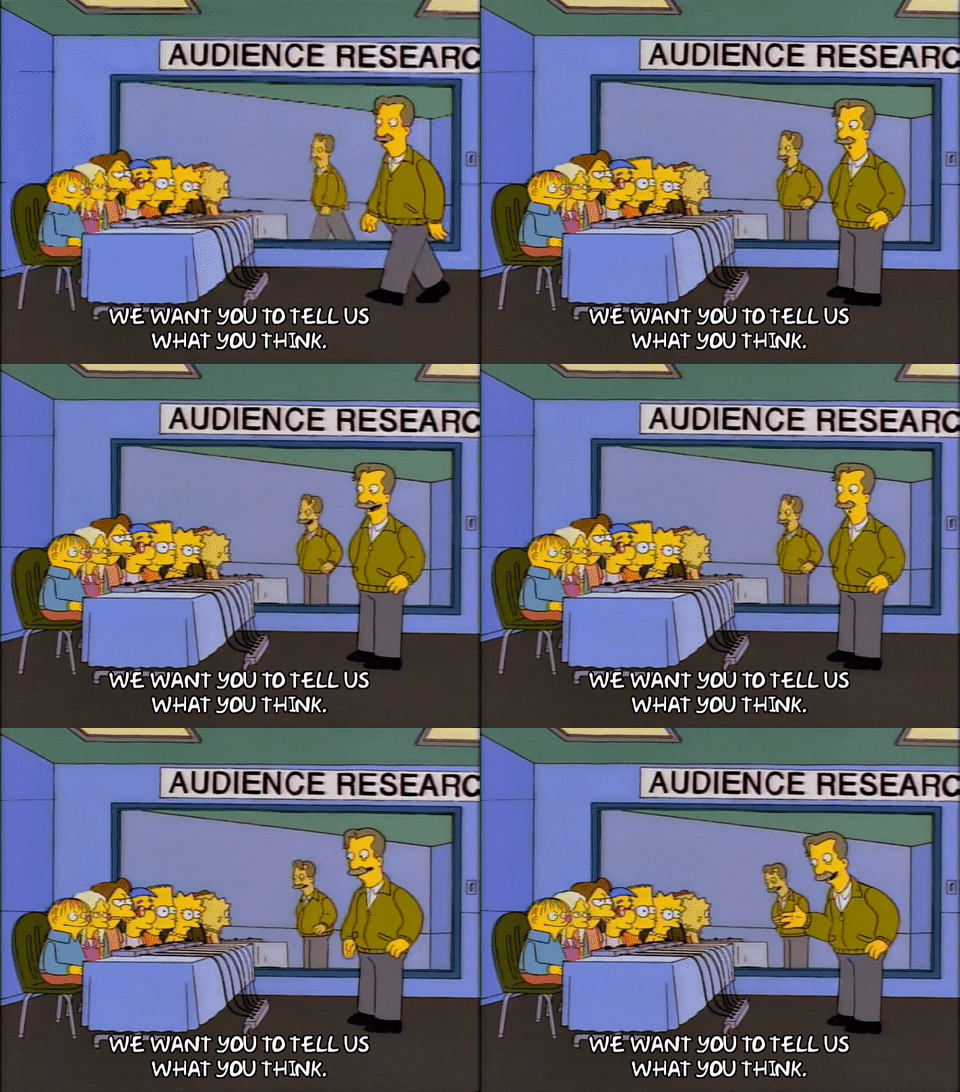
Listen. It’s not (all) about the methodology.
The design of the research is important, don’t get me wrong. You want to pick the right tool for the job — some decisions are social and would be better explored in a group discussion; some decisions are sensitive and would be better discussed one-on-one; sometimes we have the time and budget to be in person with everyone, sometimes we need remote, asynchronous tools; sometimes we want to talk to the same people more than once, other times once is enough. We might need to build out stimulus for discussions, design activities for co-creation, develop activity and discussion guides for facilitators, and so on. Specific methods matter, but they won’t matter if you don’t center everything you do on this:
In the end, it’s not about you. It’s about them.
You can want a prospect to be a customer; you can want a customer to be a more frequent customer, more loyal, less price sensitive, more of an advocate for you. You can be laser-focused on ways to “get them” to engage in the behavior that benefits you.
But if it doesn’t fit with their mental models, their real lives, their values and beliefs, it doesn’t matter how much you want it — you’re not going to get it.
The other day I said to my business partner, “We always talk about ‘meeting people where they are’. But I think the real trick of marketing is we meet them where they are, and we don’t leave them there.”
She put it much more succinctly: “We meet them where they want to be.”
That’s it.
That is the whole ballgame when it comes to anything like persuasion.
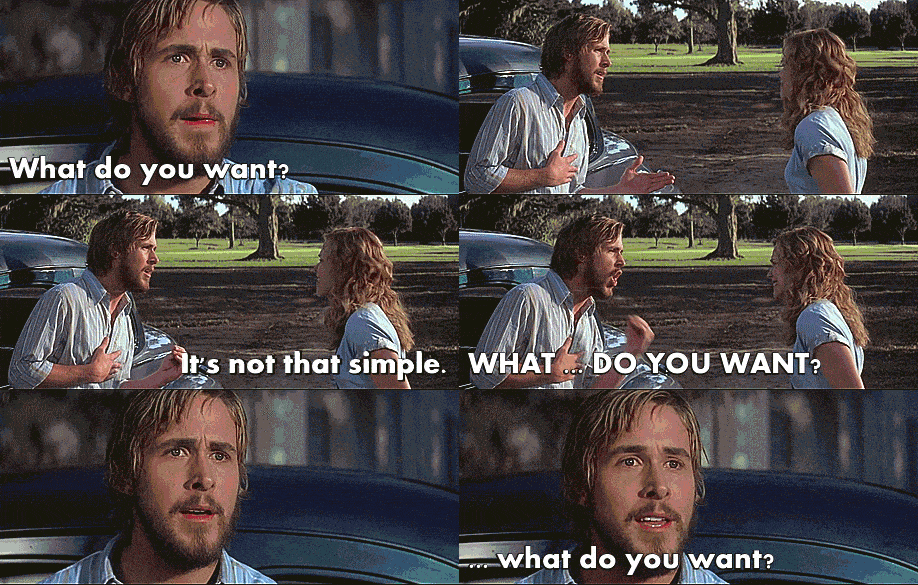
We’re not trying to persuade a customer that we’re right and they should agree with us. We’re trying to persuade them that they’re right about what they want1, we want them to have it, and we’ll help them get it.
This is why marketers talk about storytelling — not because we turn every ad into a Hero’s Journey, but because people understand the world by, in a sense, narrativizing it. They explain to themselves what just happened; they speculate about what’s going to happen; they rationalize why it happened; they plan what they’d like to do differently next time; they imagine a future state that is better than this one (and for you catastrophizers out there, imagine a future state that is worse, too). They think in terms of heroes and villains, of obstacles to overcome, of values and beliefs.
Brands loop into the narration — they add things, shade them, fill them in. And they interrupt the narration sometimes, too, to say, “what if?” Brands use marketing to plant seeds.
“What if you felt better about yourself?”
“What if you could do it?”
“What if you had support, a hand on your back, a friend?”
“What if this was easier?”
“What if it’s possible?”
I’m not delusional — plenty of brands plant invasive seeds of (self)doubt.
“What if you’re not as good as them?”
“What if you are failing?”
“What if it’s their fault?”
Acceptance
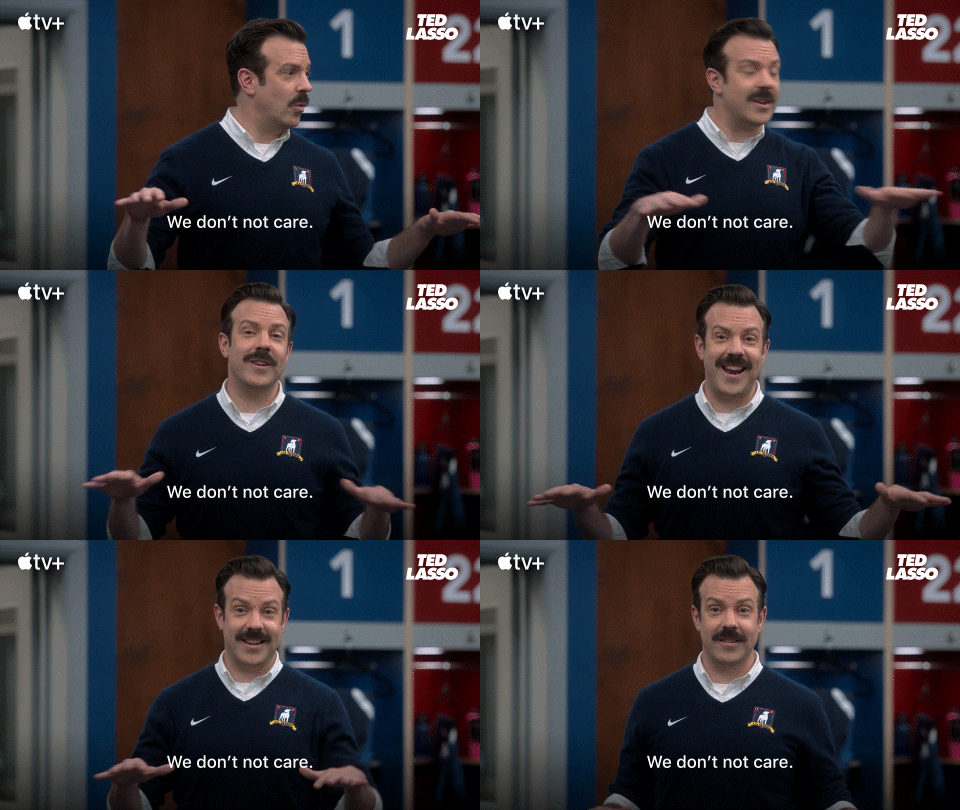
The core of all of this is acceptance. We very rarely talk about “changing” a consumer. Brands are trying to figure out how to motivate them, harness something within them, connect with them in a way that makes them want to keep connecting with us.
It doesn’t always have to be deep. Sometimes it can just be a relationship of convenience — we can make it so seamless and easy and consistent and satisfying they’ll just… form a habit around the brand.
So in this phase after we’ve gained some radical clarity and transparency about what the challenge really is, we need to go meet people where they want to be.
What is their desired destination? Why do they want this? What good will it do for them? What problem will it solve? How will it make them, or their lives, better?
We need to understand how close or far from that destination they feel they are, what’s getting in their way and what’s propelling them. We need to understand how optimistic and pessimistic about getting there they are; how much friction is good, and how much is discouraging; what voices are influencing them to try to get there or to be cautious or to give up. We need to know what trends and technologies and narratives are shaping their understanding of both themselves, and where they want to be.
This is the point of the first wave of research, which must be qualitative (I’ll say more in a moment about why): we need to know who we’re talking to and how to talk to them so they can hear us but feel like they’re hearing themselves.
But there is a trick to doing this well: you can’t lie. At least, not for long.
Respect
A friend and former mentor/ boss of mine said to me the other day, “The MAGA Republicans sure do have a lot of contempt for their voters.”
I agreed, but I added a few observations: “They do, but they still accept them as they appear to be. The Democrats also have contempt for their voters, and they wish they could get better ones.”
The best brand strategy research work I’ve ever done have left my clients with more respect for their customers, not less. They’ve learned that viewers they thought were “less than average Joes” were actually pretty great, and had taste. They’ve learned that returning students aren’t scared of failing, they’re scared that when they stumble, no one will offer them grace. They’ve learned that people people want to trust and respect their bank, but instead feel like they’re always one misstep away from punishment. They’ve learned that sometimes shopping isn’t seeking a thing it’s having an adventure.
If you have respect for the people you’re talking to — and I just mean the bare minimum human respect you owe to any other human being — you’ll discover these desires and experiences and find within them points of meaningful connection.
If you have contempt for the people you’re talking to, you’ll do something else.
The MAGA Republican version of this is to focus on the negative side of the desire — the deprivation, the obstacles, the difficulty — with something like, “Yeah, you’re getting screwed. It’s those guys over there. We’ll take care of ‘em.”
They don’t offer to make you whole or fix what’s broken or make things better for you; instead they promise to go beat up your enemies. If the bully stole your lunch money, they’ll go steal the lunch money from the bully. (They just won’t give it back to you, though. They’ll keep it. You want them to keep it, right? They did you a solid, and they didn’t have to, you know.)
The Democrats’ version of this depends on the candidate, but a lot of swingy voters hear something like, “Oh, sweetie, I’m sorry it’s hard. We wish it was easier too. I mean, some people are managing just fine, but we know it can be hard… for some people. Hey! You know what? I have this gift card I’m not going to use. It’s only good at that one place, and it’ll expire in a few months, and you can only use it online, but you can’t use it if you’ve shopped there before. Anyway, I hope it helps. Good luck!”
What do we get for the effort?
I’ll speak for myself and tell you that I find this kind of work to be deeply fulfilling. I have said over the years that my clients hire me but I work for their customers. I’m not simply a conduit for the words they say, I’m their advocate. In my mind, that’s the whole point of research and strategy — to represent the voice of the customer, and to do so vigorously and affirmatively, and to use it to inspire change.
But I know what some of you are thinking: that’s nice, but will it be a big enough sample? Will the respondents be representative? Is it going to be statistically significant?
Listen. It’s qualitative. It’s not meant to be described using percentages. I don’t do a focus group of 8 people and tell you that 40% of them thought something. I tell you that Jayden, Linda, and Maria all want this one thing, but they want it for slightly different reasons.
So what’s the use? If you can’t use this to buy media, or score 16 messages, is it even research?
There are a few critical reasons for doing qualitative research, and for doing it first — see, I said I’d get back to it!:
We need to understand the frames people use, and the specific language they use so we can write a survey instrument that makes sense to ordinary people. Survey designers are not ordinary people, so we need some help to figure out how to talk about things, offer options, and frame choices in a way that feels real, and relatable.
We need to check our assumptions about what matters to people. If we go into fieldwork thinking everybody cares about X, but they don’t care about X, they care about C, G, Q and R, in about equal measure because they are in tension or cohesion with each other, then we need to know that before we spend too much energy on X. This initial wave of research often reveals the things we are most wrong about.
We need ideas! Often we discover opportunities that weren’t on our initial SWOT analysis, threats we didn’t see coming; we might even uncover strengths and weaknesses that customers care more about than we did at the start. This can help us develop positioning statements, concept descriptions, product features and benefits that we might not have without this insight.
It doesn’t have to be a massive, time-consuming undertaking
We routinely spend somewhere between 6 and 12 weeks doing this phase of work. It takes time to recruit and screen people, to get them scheduled for interviews or groups (or set up in diary platforms), and to field the research. It takes some time to develop the activity guide and stimulus. It takes some time to review transcripts and recordings, to code the data, to identify themes, and to develop recommendations based on the findings. But it doesn’t take forever.
We advocate for a qual-quant-qual approach, and in the context of this imagined project, that’s what I’d recommend. We’d canvas a wide array of people representing the diverse demographics of current and prospective voters. We’d use our analysis to develop some personas (more on that in a subsequent post), and we’d use quantitative research to ‘size and prioritize’ — figure out how many of each persona there are in the voter universe, probably discover a couple more, and score them based on how big of an opportunity they represent for growth (this might include how many of them they are, where they live, how often they vote, how enthusiastic they are about voting, how hard they might be to reach or persuade, etc.).
And then we’d go back out to meet with these people (online, in person, whatever), but this time, they’d be segmented into those personas. We’d show them more stimulus (messaging ideas, or policies, or candidates, or slogans, or media ideas, etc.). Some of that stimulus might be tailored to specific persona groups. We’d explore those ideas with them, figure out what’s working and what’s not, and how to make it better.
But always, we’re trying to make a meaningful human connection, to meet people where they want to be.
Which ought to be what politics is for, you know?
More on what personas or segments are next time.
I mean, there are limits to everything.