What Power is For

There is an update I want to share with you, a new episode I want you to know about, and an idea I'd love someone to take me up on.
Updates
After a great deal of laziness, I decided to move the newsletter back to Ghost. For those who have already subscribed, nothing changes about your subscription - you'll still get these occasional newsletters from me, in your email. However, you won't be seeing those updates in the Substack app.
I imagine that this will make it harder for people to find the newsletter - if they're primary method of finding newsletters is through Substack. I hope you'll stick with us though, and that you'll forward these newsletters to friends and encourage them to subscribe.
I did not do this because this is such a massive subscriber base and I don't need to grow the audience - there are about 400 of you who subscribe, which is incredible. I'm so grateful you're here. But I also know there are a lot of people who refused to subscribe because the newsletter was hosted on Substack.
So why leave, and why now? I think there were three factors:
- The Nazi Bar Problem. Every few months, another article comes out highlighting how Substack makes money off white supremacists. Every few months, a massive bout of guilt for even symbolically supporting Substack. As I think about potential future monetization of Cross Tabs, I didn't want to share revenue with people who don't mind skimming revenue off of people who are actively trying to undermine democracy, equality, and civil society.
- The "Don't Call It a Substack" Effect. Anil Dash wrote quite eloquently about this on his own blog/newsletter. Marketing influencer Seth Godin followed his lead. In the world of marketing, we used to talk about the distinctions between different kinds of channels: paid, earned, and owned. Paid channels are, generally, advertising. I do not pay for any advertising for the show. Earned channels are ones in which you are mentioned by someone else, traditionally this was the work of PR, but it has sort of devolved into a paid-earned-hybrid universe of influencer marketing. Owned channels were, once, your own website, your own newsletter, your own blog. When social media came along, it sort of turned over the table – was your Facebook page "owned" or ... borrowed? When you write a newsletter and you work to find subscribers but you call it your substack, you're subsuming your brand under the Substack brand – which strengthens their brand and weakens yours. It is utterly dismaying how many small businesses don't have their own websites – just Facebook pages and Yelp profiles. I own the crosstabspodcast.com URL, I should get full ownership of my brand. You'll never hear me talk about "my Ghost". If I'm going to give advice, I should probably follow it – and I would give this advice to any brand I work with. There's more than one way to pursue "network effects".
- The "I Don't F*cking Care What You Think" Moment. In Tina Fey's memoir, Bossypants, she tells this story about Amy Poehler cracking jokes and apparently grossing out Jimmy Fallon who says something like, "ew, gross!" and Amy spins on him, and in a complete turn from kidding around says, with the presence of Lord Vader himself, "I don't fucking care what you think." I guess I have entered a phase of my life where it feels a lot like doing things the way every system I encounter seems to want me to do things isn't working, maybe never really worked. So why keep living in trusting obedience to these systems? I suppose that because we are in a very weird period for the industry I work in, and to be perfectly honest, we have very few projects going right now, I don't have the "they're paying me to" effect operating on my conscience as much as I have before. I've been handling work scarcity for so long that I think I've decided to abandon a defensive crouch and instead embrace the YOLO of it all. So screw it, I'm not writing for Substack's benefit anymore.
If you do not want to have to read an email, if you simply prefer the Substack app experience and want all of your newsletters in that kind of reader/feed, you are free to unsubscribe (see email footer). I hope you won't, though.
By the way, if like me you subscribe to a lot of different newsletters hosted via many different platforms (beehiiv, Ghost, buttondown, et al), there are some pretty cool apps – some free, and some paid – that will skim your email for anything that looks like a newsletter, aggregate it into a connected app and allow you to read those newsletters in one place. I've been trying out something called Meco, which doesn't sell data or ads, doesn't store or process your emails, and seems pretty pleasant to use. [Not a paid sponsor, just something to take a look at if you're in the market.]
On with the show
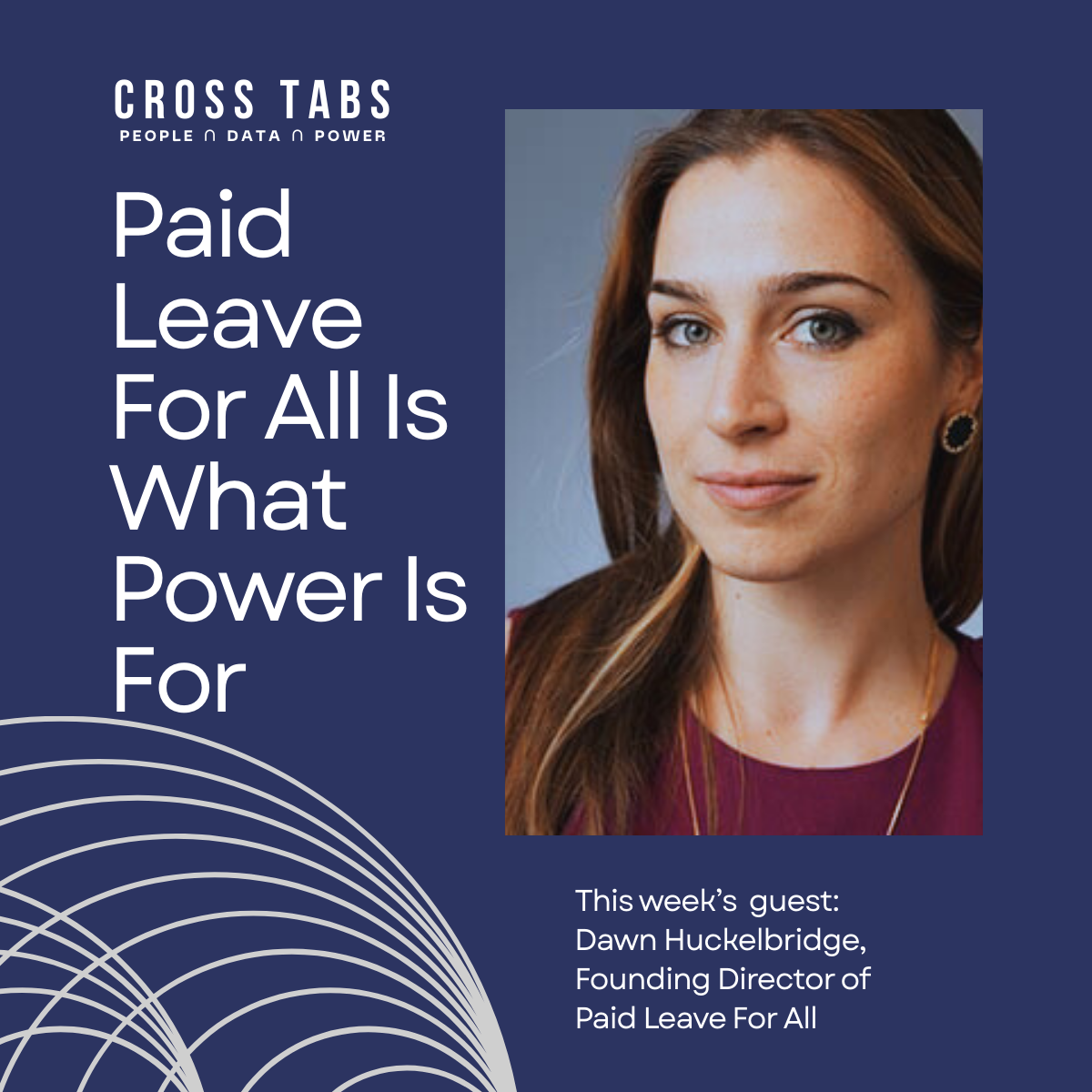
This week's episode of Cross Tabs features Dawn Huckelbridge, founding director of Paid Leave for All, and founder of Paid Leave PAC. We talked about their effort to finish a job started 30+ years ago with FMLA to ensure paid, government-funded, family and medical leave for all workers. They got close to passing it in 2021, states continue to pass their own state-level paid leave programs, small business owners and workers all love the idea. Good things are still possible, and this is one of those things that, if Democrats do manage to take back the House and Senate, they should take back up immediately and pass. We're one of only a handful of countries in the world that do not offer this benefit to our workers.
This is what the power is for.
Here's the episode: [embedded on web, who knows in the email?]
One particularly interesting data point from our conversation is that in states with paid parental leave for all workers, men are taking the benefit at similar rates to women from the start with newer programs, and catching up to women with older programs. You can read more about what they found here.
A theme I think needs to be elevated in Democratic campaigning is solidarity. Rather than thin-slicing policies to help people who may be disproportionately affected by the lack of support – a worthy notion, to be sure – offer the policy to everyone. Instead of letting issues be cast as "women's issues" or "Hispanic issues" or "youth issues", taking a broader view of how those issues impact everyone's lives could go a long way toward softening the zero-sum scarcity mindset voters have been trained to adopt when thinking about what candidates and parties are offering to voters.
I also simply despise means-testing, but that's a topic for another day.
Tracking n=1 Opinion Shifts
Axios reported yesterday that across several polls, voters are comparing Trump unfavorably to Biden.
What a difference a year makes.
Axios says:
Three national surveys point to the same alarming trend for a president who's done everything in his power to erase his predecessor's legacy.
Harvard CAPS/Harris (Jan. 28–29): Mark Penn's polling firm found that 51% of registered voters say Trump is doing a worse job than Biden, compared with 49% who say he's doing better.
Rasmussen Reports (Feb. 2–4): The Trump-friendly pollster is fending off MAGA criticism after finding that 48% of likely voters say Biden did a better job as president, compared with 40% who chose Trump. Another 8% said the two presidents have performed "about the same."
YouGov/Economist (Feb. 6–9): This survey found that 46% of U.S. adults say Trump is doing a worse job than Biden, compared with 40% who say he's doing better. Another 7% said "about the same."
I mean, et tu, Rasmussen?
Whoa! Didn’t expect to wake up to this news. “A year into Trump’s term, voters say Biden was better.” Trump’s net approval on the economy is now -18. That’s 26 points worse than this point in his first term and a brutal 53 points lower among independents. 1/2
— Christopher Webb (@cwebbonline.com) 2026-02-13T13:30:57.419Z
So, there's a funny thing that happens in brand trackers. Brand trackers are regular surveys in which a similar size/composition sample is asked the same sets of questions about a brand and its category over time. Some brands do them monthly, some quarterly, some annually (many, never). But one of the things about brand trackers – a thing that makes them valuable – is that they're typically stable over time. Why on earth would it be valuable to spend all that money measuring opinions that hardly change? Because when they do change, you want to know. And you want to know why.
But hidden beneath the steady surface is actually quite a bit of churn. If you were to sample the exact same set of people each time, and look at their individual responses, you should expect to see quite a lot of wobble in their brand perceptions. People just aren't that "consistent" about their opinions – which is another way of saying that people's opinions are context-dependent. If this month I had a generally positive experience of a brand I purchase frequently, I'll give it pretty good marks; if next month the product disappoints me, I'll be comparatively very negative about it.
Now – from a broadcast-level marketing perspective, these little wobbles aren't that important. Most likely, next month, my experience of the brand will normalize, and I'll go back to saying nice things about it.
But from a delivery perspective, those wobbles matter quite a bit. While it is often cheaper to simply acquire new customers than retain old ones for a lot of mass-market, top tier brands, for brands that are trying to gain traction, or have lost a lot of ground, or have simply stagnated, these dips and spikes could contain a lot of signal about why growth is so hard.
This is why many brands have their own consumer panels – a steady group of consistent respondents who give them regular feedback over time. There's always some churn in the makeup of a panel – people drop out and have to be replenished – but when people who (a) have opted in to participate in your panel and (b) regularly engage with you provide you with feedback, there is a value to that.
If anybody's game, I'm interested in offering brand marketing-style research services to political groups. And if anybody wanted to pool resources for a kind of omnibus panel study, in which we asked the same people consistent questions over time, and could therefore track not just the trends, but the respondent-level wobbles, we could understand quite a bit about how opinions are evolving in real time – like, why people who said things were better under Trump Part 1 might now be saying things were better under Biden.
I can imagine setting up a 1000-person representative panel, replenishing as needed, and conducting a combination of qualitative and quantitative queries among the panelists to understand not just what they're feeling, but what's driving those feelings. It's not that hard.
But it does cost money. Oh to be independently wealthy! Anyway, if it sounds fun, hit me up!
Thanks for reading this far! See you next week.